


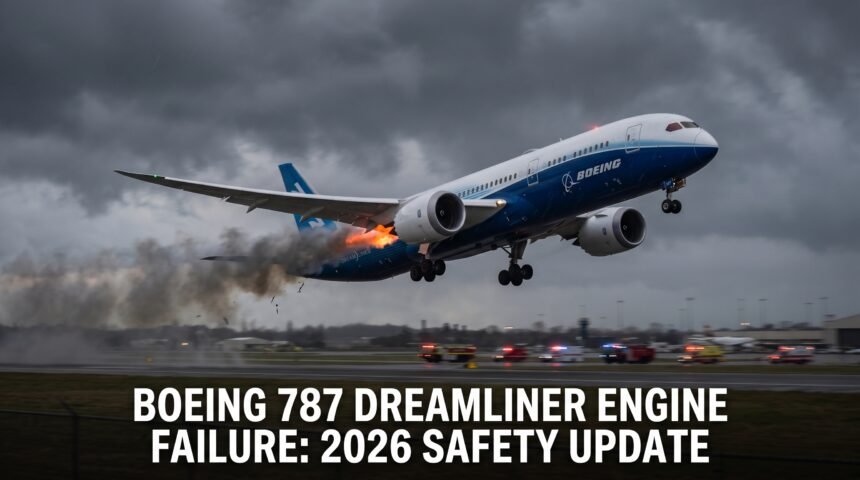
Boeing 787 Dreamliner engine failure became a major concern for passengers and aviation experts after two serious events in 2025. One flight ended with a safe emergency landing, while the other resulted in a tragic crash. Many people now want clear, honest answers about what went wrong and how safe the Dreamliner is today.
- Recent Boeing 787 Engine Failure Incidents
- Boeing 787 Engines: GEnx vs Trent 1000
- Known Causes of Boeing 787 Dreamliner Engine Failure
- How Pilots Handle Engine Failure on the Boeing 787
- Boeing 787 Dreamliner Safety Record in 2026
- Boeing and Regulatory Responses
- Why These Incidents Raise Public Concern
- Future Outlook for the Boeing 787
- Frequently Asked Questions
- Conclusion
In this article, we cover the key incidents, engine types, possible causes, pilot actions, and the latest safety updates as of 2026. We also look at what sets the Boeing 787 apart and what lessons are being learned.
Recent Boeing 787 Engine Failure Incidents
Two high-profile cases in mid-2025 brought the topic of Boeing 787 Dreamliner engine failure into the spotlight.
United Airlines UA108 Engine Failure – July 25, 2025
On July 25, 2025, United Airlines Flight UA108, a 12-year-old Boeing 787-8 Dreamliner (registration N27901), took off from Washington Dulles International Airport (IAD) heading to Munich, Germany.
Just minutes after takeoff, while climbing through about 5,000 feet, the left engine failed. The pilots immediately declared a mayday, mayday, mayday, telling air traffic control: “Engine failure, left engine, United 108 declaring an emergency.”
The crew dumped fuel to lighten the aircraft, entered a holding pattern northwest of Washington D.C., and safely returned to Dulles after roughly 30 minutes in the air. All 230 people on board (219 passengers and 11 crew) landed safely with no injuries reported. The plane was later towed off the runway.
This United Boeing 787 engine failure during the critical takeoff phase showed how quickly crews must respond. Audio recordings of the mayday call and air traffic control communication went viral, increasing public attention.
Air India Flight 171 Crash – June 12, 2025
Just six weeks earlier, tragedy struck with Air India Flight 171. The Boeing 787-8 Dreamliner (registration VT-ANB) crashed only seconds after takeoff from Ahmedabad, India, bound for London Gatwick.
According to the preliminary report by India’s Aircraft Accident Investigation Bureau (AAIB), both engines lost thrust after the fuel control switches moved from “RUN” to “CUTOFF” position roughly one second apart. The Ram Air Turbine (RAT) deployed, but the aircraft lost altitude rapidly and crashed into a medical hostel area.
Out of 242 people on board, only one survived. The total death toll reached approximately 241 to 260 people, including victims on the ground. As of early 2026, the final investigation report is still pending. New discussions include possible electrical failures in the days before the flight and questions about whether the fuel switch movement was intentional or due to a system fault.
These two events, occurring so close together, created the perception of an “eerily similar” pattern in Boeing 787 Dreamliner engine failure cases.
Boeing 787 Engines: GEnx vs Trent 1000
The Dreamliner can be powered by two different engines — the General Electric GEnx-1B or the Rolls-Royce Trent 1000.
GEnx engines are used on the majority of the fleet. Airlines often prefer them for better fuel efficiency, longer time on wing, and fewer unplanned maintenance events. Earlier problems with ice crystal icing and fan ice shedding were largely addressed through airworthiness directives.
Trent 1000 engines had more serious early durability issues, especially blade cracking and corrosion between 2016 and 2018. These problems led to temporary groundings for some airlines. Rolls-Royce has introduced upgrades, including better cooling in newer versions, but the GEnx still holds a stronger reputation for reliability among many operators in 2026.
Here is a simple comparison:
| Aspect | GE GEnx-1B | Rolls-Royce Trent 1000 |
|---|---|---|
| Market Share | About 61% | About 32% |
| Reliability | Fewer unplanned removals | Improved but more maintenance historically |
| Fuel Efficiency | Excellent | Competitive |
| Known Past Issues | Ice crystal icing (mostly fixed) | Blade cracking and corrosion |
Many airlines switched to GEnx after experiencing Trent 1000 problems, which explains ongoing talks about GEnx vs Trent 1000 reliability.
Known Causes of Boeing 787 Dreamliner Engine Failure
Engine power loss can happen for several reasons. Single-engine failures are rare but the 787 is designed to fly safely on one engine thanks to ETOPS certification.
Common causes include:
- Fuel control switches moving to cutoff
- Ice crystal icing at high altitude
- Blade fatigue or material defects
- Electrical system disturbances affecting engine controls
In the United UA108 case, the failure was limited to one engine. In Air India Flight 171, the dual engine power loss raised bigger questions. Some reports mention multiple electrical failures and malfunctioning parts in the 48 hours before the crash. Whistleblower claims have also linked the incident to possible latent defects across the 787 fleet.
Important: Dual engine failure is extremely rare in modern aviation. The aircraft has multiple backup systems, including the Ram Air Turbine.
How Pilots Handle Engine Failure on the Boeing 787
Pilots practice engine failure scenarios regularly in simulators. For a single-engine event like UA108, the steps are clear: maintain control, declare the emergency if needed, dump fuel if returning to land, and follow checklist procedures.
In a dual-engine situation, the workload is much higher. Pilots attempt to relight the engines while the Ram Air Turbine (RAT) provides emergency power. Cockpit voice recordings from Air India 171 reportedly captured confusion between the pilots regarding the fuel switches.
The successful safe emergency landing by the United crew highlights excellent training and quick decision-making under pressure.
Boeing 787 Dreamliner Safety Record in 2026
Before 2025, the Boeing 787 had flown for nearly 15 years with an outstanding record and no fatal hull-loss accidents. Over 1,100 aircraft were delivered, carrying hundreds of millions of passengers safely.
The Air India Flight 171 crash became the first fatal accident for the type. Even with this tragedy, experts note that commercial aviation remains one of the safest ways to travel. However, the incidents have increased scrutiny on Boeing’s manufacturing quality and electrical systems.
As of 2026, airlines and regulators continue to monitor the fleet closely, with some operators performing extra checks on fuel systems and electrical components.
Boeing and Regulatory Responses
The FAA, NTSB, and India’s AAIB are involved in the investigations. Several airworthiness directives have been issued over the years for both engine types.
Following the incidents, Air India inspected fuel control switches across its 787 fleet. Boeing has stated it is fully cooperating with all probes. Whistleblower reports submitted to the US Senate have called for deeper reviews of possible systemic electrical issues in the 787 fleet.
Why These Incidents Raise Public Concern
The close timing of the United and Air India events led to headlines about aircraft safety concerns and national tragedy. Families of victims continue to seek answers and accountability.
At the same time, aviation professionals point out that single-engine failures are manageable, while dual failures are exceptionally uncommon. Thorough investigations help improve safety for everyone.
External Resource: For official preliminary findings on Air India Flight 171, see the AAIB report summary here.
Future Outlook for the Boeing 787
Engine manufacturers continue making improvements. GE focuses on even better reliability with the GEnx, while Rolls-Royce pushes upgrades to the Trent 1000.
Final investigation reports expected in 2026 may lead to design changes, updated procedures, or additional inspections. Many believe the Dreamliner will become even safer as lessons from these events are applied.
External Resource: Read more about GEnx and Trent 1000 differences in this detailed comparison: GEnx vs Trent 1000 Analysis.
Frequently Asked Questions
What caused the United UA108 engine failure? The left engine failed shortly after takeoff at around 5,000 feet. The aircraft returned safely after fuel dumping.
Was Air India Flight 171 caused by engine failure? Yes, both engines lost power due to fuel control switches moving to cutoff. The full cause is still under investigation, with some reports discussing electrical issues.
How safe is the Boeing 787 in 2026? The aircraft maintains a strong overall safety record. The 2025 events are being studied carefully to prevent future occurrences.
Can the Boeing 787 fly on one engine? Yes. It is certified to do so for long distances under ETOPS rules.
Conclusion
Boeing 787 Dreamliner engine failure incidents in 2025 understandably worried many people. The safe handling of the United UA108 mayday shows the strength of pilot training and aircraft design, while the Air India tragedy reminds us that every incident must be fully understood.
Aviation improves through transparent investigations and continuous upgrades. As we await final reports in 2026, the focus remains on safety, accountability, and learning from every event.
Flying is still statistically very safe. If you have concerns about your next trip, remember that thousands of Dreamliners continue to operate reliably every day.
This article is for informational purposes and is based on publicly available reports as of May 2026. Always check official aviation authorities for the latest updates.
Go to Sac Biz News for more quality, informative content