


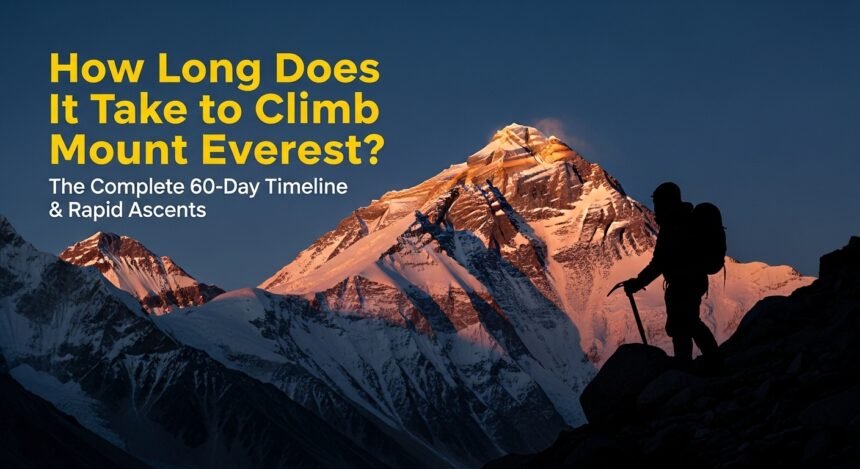
How long does it take to climb Mount Everest is the first question every aspiring mountaineer asks before attempting to stand on the roof of the world. Reaching the absolute peak of the Earth at a staggering 8,848.86 meters (29,031.7 feet) is not a casual hike. It requires incredible physical endurance, precise logistical planning, and a deep respect for extreme altitude.
- The Short Answer: How Many Days Does It Take?
- The Traditional Everest Climbing Timeline
- Phase 1: The Everest Base Camp Trek (10–14 Days)
- Phase 2: Acclimatization Rotations (40–45 Days)
- Phase 3: The Summit Push (5–7 Days)
- Phase 4: The Helicopter Descent (1–3 Days)
- Rapid Ascent: Climbing Everest in 3 to 4 Weeks
- Comparing Everest to Other Mountains
- The Hidden Timeline: Pre-Climb Preparation
- Final Thoughts
For a traditional expedition, the average time to climb Mount Everest is 60 to 65 days (approximately two months). This complete timeline covers your arrival in Nepal, the long approach trek, vital acclimatization, and waiting for the perfect weather window.
However, depending on modern techniques, your budget, and your guiding team, this Mount Everest climbing timeline can actually be cut in half. Let’s break down exactly where all those days go.
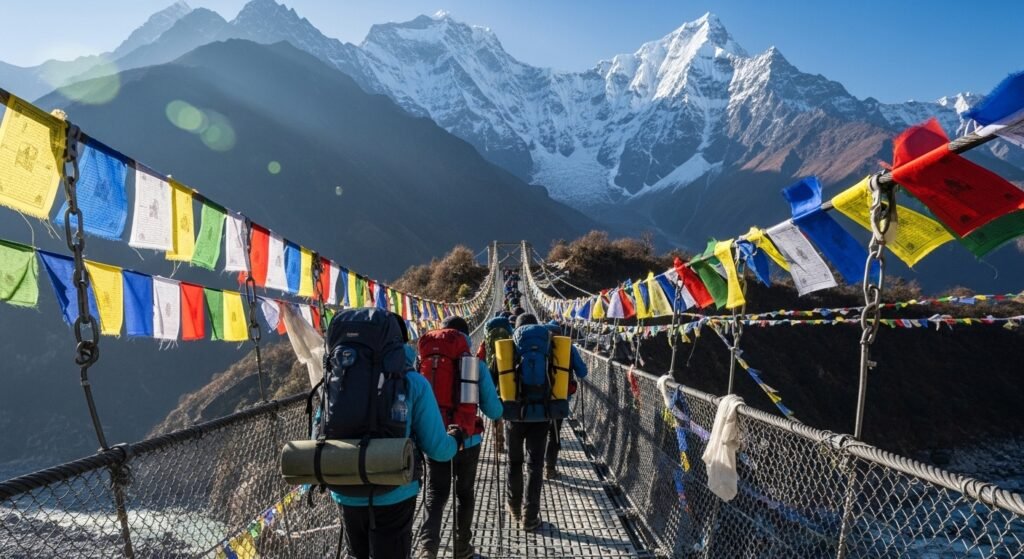
Caption: Scaling the world’s highest peak requires immense patience and time for acclimatization.
The Short Answer: How Many Days Does It Take?
If you are looking for the exact Mount Everest climb time, the vast majority of climbers follow this schedule:
- Standard Expedition: 60 to 65 days.
- Rapid Ascent Expedition: 21 to 28 days (3 to 4 weeks).
To understand why a traditional Everest expedition duration takes two full months, we have to look at the biology of high-altitude mountaineering.
The Traditional Everest Climbing Timeline
You cannot simply rush to the top of an 8,000m peak. If a human were teleported from sea level directly to the summit, they would lose consciousness in minutes due to hypoxia. Your body needs time to adapt.
Here is the traditional Everest climbing itinerary via the South Col route:
| Expedition Phase | Activity & Location | Duration | Altitude Reached |
| Phase 1 | Trek to Everest Base Camp | 10 to 14 Days | 5,364m (17,598 ft) |
| Phase 2 | Acclimatization Rotations | 40 to 45 Days | Up to 7,162m (23,500 ft) |
| Phase 3 | Weather Window & Summit | 5 to 7 Days | 8,848.86m (29,031 ft) |
| Phase 4 | Descent to Kathmandu | 1 to 3 Days | Return to Sea Level |
Phase 1: The Everest Base Camp Trek (10–14 Days)
The journey begins with a thrilling flight from Kathmandu to the mountain airstrip of Lukla. From here, the Everest Base Camp trek duration takes roughly 10 to 14 days.
Climbers hike very slowly through the Khumbu Valley to avoid altitude sickness. This trek is also a deeply cultural experience. Climbers stop in villages like Namche Bazaar and visit the famous Tengboche Monastery to receive a blessing from the local Lama. By the time you reach Base Camp at 5,364 meters, you have already been traveling for two weeks.
Phase 2: Acclimatization Rotations (40–45 Days)
This phase consumes the bulk of your trip. To prepare for the summit, climbers must complete a grueling series of acclimatization rotations.
To survive the thin air, climbers must climb high and sleep low. They navigate the dangerous Khumbu Icefall to reach Camp 1 and Camp 2, spend the night, and then drop all the way back down to Base Camp. A standard expedition requires at least three of these upward rotations, eventually reaching Camp 3 (7,162 meters) before resting. These climbs, combined with mandatory resting days, take 40 to 45 days.
“The true test of Everest is not summit day. It is having the mental fortitude to survive 40 days of freezing temperatures and exhaustion at Base Camp.”
Phase 3: The Summit Push (5–7 Days)
By mid-May, the Mount Everest climbing season peaks. Climbers wait for the jet stream winds to fade. Once the weather window opens, the final push takes 5 to 7 days.
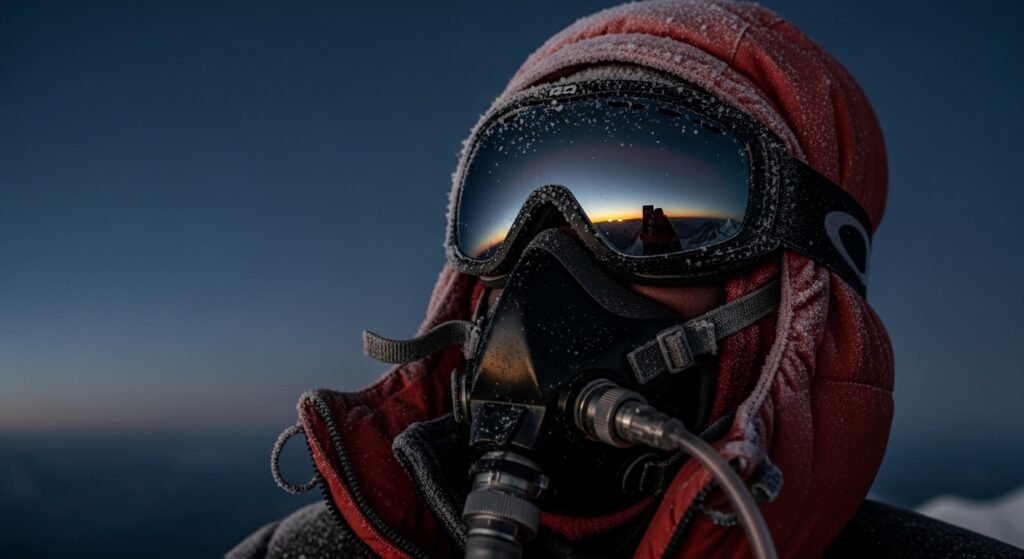
Above 8,000 meters, climbers enter the Death Zone, where there is only 30% oxygen compared to sea level. Here, elite guiding agencies use a 1:1 Sherpa-to-client ratio. Having dedicated Sherpa climbing guides speeds up the climb immensely, as they manage the supplemental oxygen (flowing at 2 to 4 liters per minute) and help navigate bottlenecks.
Phase 4: The Helicopter Descent (1–3 Days)
Reaching the top is only half the battle. Climbers must obey a strict 2:00 PM turnaround time to avoid running out of oxygen. Historically, the hike down took a full week. Today, climbers finish the expedition fast by hiring helicopter returns directly from Base Camp back to Kathmandu, saving 3 to 4 days of walking.
Rapid Ascent: Climbing Everest in 3 to 4 Weeks
Case Study: The Hypoxic Advantage
For modern climbers who cannot spend two months away from home, the Everest flash expedition is the ultimate solution. Climbers rent an altitude generator and sleep in a hypoxic tent at home for four weeks before flying to Nepal. Because their bodies pre-acclimatize, they can skip the 14-day approach trek entirely, fly a helicopter directly to Base Camp, and complete a rapid ascent Everest climb in just 21 to 28 days.
The Safety Factor: Interestingly, a shorter rapid ascent Everest timeline actually increases your safety. Spending less time doing rotations means you spend significantly fewer hours exposed to the unpredictable avalanches inside the Khumbu Icefall.
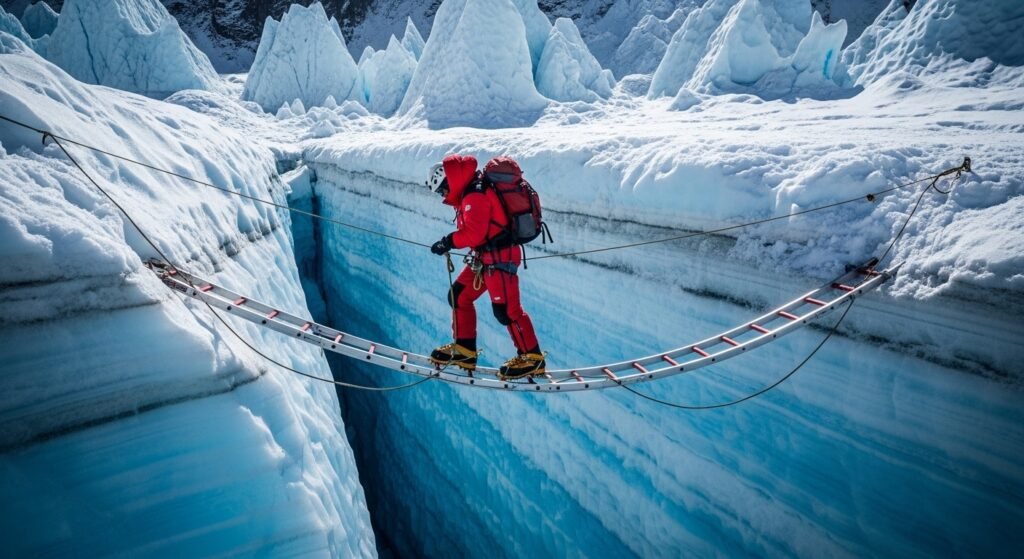
Caption: Proper training and modern acclimatization strategies have made climbing the highest peaks safer and faster.
Comparing Everest to Other Mountains
When looking at climbing Everest vs other mountains, you quickly realize why the Himalayas require such a massive time commitment.
| Mountain | Location | Altitude | Average Climb Time |
| Mount Kilimanjaro | Tanzania | 5,895m | 6 to 8 Days |
| Denali | USA | 6,190m | 21 to 24 Days |
| Mount Everest | Nepal | 8,848m | 60 to 65 Days |
As shown, Everest takes nearly ten times longer than climbing Kilimanjaro due to the extreme altitude and logistics.
The Hidden Timeline: Pre-Climb Preparation
If you are researching how long does it take to prepare for Mount Everest, the actual answer is years.
You must spend 1 to 2 years doing intense cardiovascular training and gaining high-altitude experience. You can review historical climber success rates and preparation habits via the official Himalayan Database. The CDC’s altitude guidelines also highly recommend experiencing lower altitude climbs before attempting an 8,000-meter peak.
Furthermore, a guided Everest climb is a massive financial commitment. The total expedition costs between $50,000 and
11,000 to $15,000 in 2025, which means climbers must secure their funding and book their agencies well over a year in advance.
Final Thoughts
So, how long does it take to climb Mount Everest? It is a multi-year journey of physical preparation culminating in a 60 to 65-day marathon of mental toughness. Whether you choose the traditional path or a modern flash expedition, standing on the roof of the world requires unparalleled patience, dedication, and respect for the mountain.
Go to Sac Biz News for more quality, informative content.