


Is psychology a social science? Yes, psychology is primarily classified as a social science by most universities, the National Science Foundation (NSF), and the American Psychological Association (APA). It studies human behavior, mental processes, emotions, and how people interact within society using scientific methods.
- What Is a Social Science?
- Why Psychology Is Classified as a Social Science
- The Interdisciplinary Nature of Psychology
- Is Psychology a Natural Science or Humanities Subject?
- Key Subfields of Psychology
- Historical Context: From Philosophy to Science
- Is Psychology a STEM Field?
- Research Methods in Psychology: Why It Qualifies as Science
- Real-Life Applications and Impact of Psychology
- Practical Implications: Careers and Job Outlook
- Why This Classification Matters in 2026
However, psychology is highly interdisciplinary. It blends elements of social science, natural science (especially in neuropsychology), and sometimes humanities. This unique position makes it one of the most versatile and in-demand fields today.
In this complete guide, we’ll break down the definitions, reasons for its classification, major subfields of psychology, research methods, career prospects, and practical implications for students in 2026.
What Is a Social Science?
Social sciences focus on understanding human society, relationships, institutions, and behavior through systematic observation and the scientific method. Common social sciences include sociology, anthropology, economics, political science, and history.
These fields examine how individuals and groups think, act, and influence one another. Psychology fits perfectly here because it explores the human mind and behavior in social, cultural, and environmental contexts.
Why Psychology Is Classified as a Social Science
Psychology is widely regarded as a social science for several key reasons:
- It centers on human behavior, thoughts, emotions, and social interaction.
- It relies heavily on the scientific method — observation, hypothesis, experimentation, and statistical analysis.
- Most colleges and universities list psychology under social and behavioral sciences.
- It shares strong connections with sociology and anthropology, particularly in areas like social psychology and developmental psychology.
Psychology as a social science helps us understand real-world issues such as mental health, motivation, leadership, and conflict resolution.
The Interdisciplinary Nature of Psychology
Psychology is often called a “hub science” because it connects multiple disciplines. While its core is social science, many branches incorporate natural science elements.
For example, neuropsychology and biological psychology study brain function and how biology influences behavior. Other areas explore subjective experiences that border on humanities.
Here’s a helpful comparison:
| Aspect | Social Science (Psychology) | Natural Science | Humanities |
|---|---|---|---|
| Primary Focus | Human behavior and society | Physical laws and biology | Culture, values, and meaning |
| Methods | Surveys, experiments, statistics | Lab experiments, empirical data | Interpretation and critique |
| Example Subfields | Social & Developmental Psychology | Neuropsychology | Philosophy of mind |
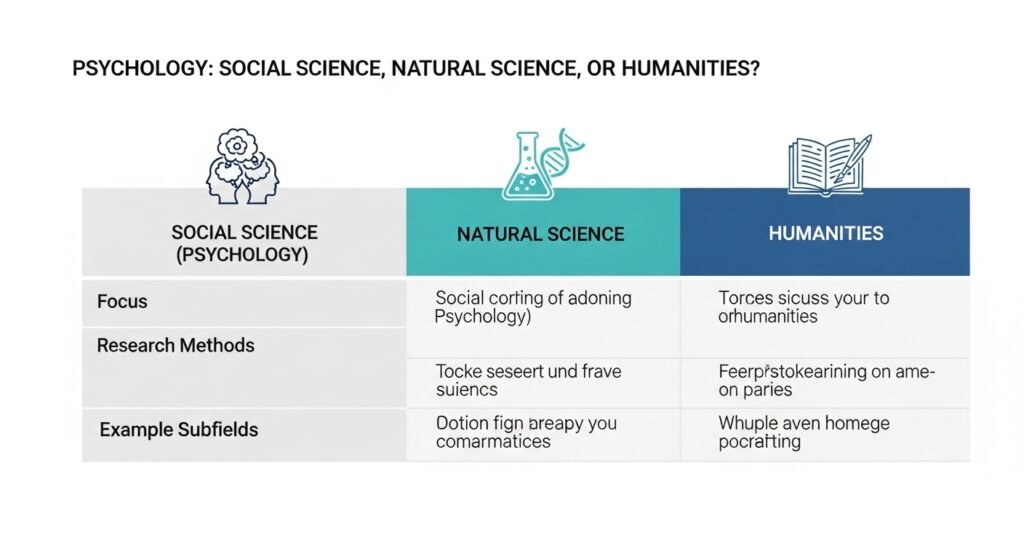
This interdisciplinary strength allows psychology to address complex human challenges from multiple angles.
Is Psychology a Natural Science or Humanities Subject?
Is psychology a natural science? Not entirely. While subfields like neuropsychology rely on biology and brain science, the majority of psychology focuses on observable behavior and mental processes in social contexts.
It is rarely classified as a humanities subject because it emphasizes verifiable evidence, reliability, and empirical research rather than purely interpretive methods.
Most experts agree: Psychology is best described as a social science with significant natural science components.
Key Subfields of Psychology
Psychology offers many exciting subfields of psychology:
- Clinical Psychology – Diagnosis and treatment of mental health disorders
- Cognitive Psychology – Memory, learning, and thinking processes
- Developmental Psychology – Growth and changes across the lifespan
- Social Psychology – How people influence and perceive each other
- Neuropsychology – Brain-behavior relationships
- Industrial-Organizational (I/O) Psychology – Workplace motivation, leadership, and performance
- Forensic Psychology – Legal and criminal justice system
- Health Psychology, Counseling Psychology, and Environmental Psychology
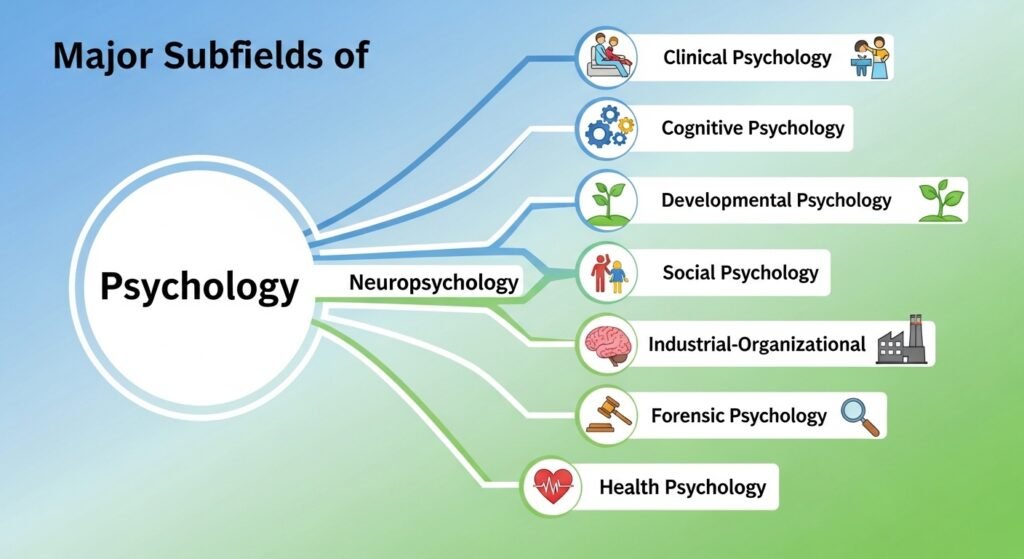
These specializations show how broad and practical the field truly is.
Historical Context: From Philosophy to Science
Psychology emerged as a distinct scientific discipline in the late 19th century. In 1879, Wilhelm Wundt founded the first experimental psychology laboratory in Germany. This marked the shift from philosophical speculation to measurable, evidence-based study of the mind.
Is Psychology a STEM Field?
Is psychology a STEM discipline? It depends on the focus. General psychology is usually categorized as a social science, but many programs in research psychology, quantitative psychology, and neuropsychology are recognized as STEM by the Department of Homeland Security. This classification benefits international students and opens access to research funding.
Research Methods in Psychology: Why It Qualifies as Science
Psychology uses both quantitative research (numerical data and statistics) and qualitative research (interviews and observations). The American Psychological Association (APA) Guidelines for Undergraduate Psychology Majors emphasize scientific inquiry, critical thinking, and the proper use of statistics.
Research is cyclical — one study often leads to new questions, building a stronger understanding of complex human behavior.
Real-Life Applications and Impact of Psychology
Psychology isn’t just theoretical. Its findings directly improve lives. For instance, research showing the negative effects of spanking has reduced its use in parenting. Social psychology studies have helped political campaigns use more effective messaging, such as “Be a Voter” instead of “Go Vote.” Virtual Reality therapy, developed with psychological insights, is now used to treat phobias, PTSD, and addiction.
Practical Implications: Careers and Job Outlook
Psychology remains one of the most popular majors. In 2021–2022, it accounted for a significant share of all bachelor’s degrees awarded in the U.S.
According to the U.S. Bureau of Labor Statistics (BLS), employment for psychologists is projected to grow 7% from 2023 to 2033 — faster than the average 4% for all occupations.
Salary Insights (BLS data):
- Median salary for psychologists: $80,370 – $94,000+ depending on specialty
- Many social science graduates see strong mid-career earnings, with graduate degrees boosting wages by up to 45%
Popular careers include clinical psychologist, industrial organizational psychologist, human resources specialist, school counselor, forensic psychologist, and substance abuse counselor.
Studying psychology also builds highly valued skills: critical thinking, empathy, communication, adaptability, problem-solving, and conflict resolution — skills LinkedIn ranked among the fastest-growing for 2025.
Why This Classification Matters in 2026
With growing mental health awareness and demand for professionals who understand human behavior, emotions, and motivation, a psychology degree offers excellent long-term value. Whether you choose a Bachelor of Science or pursue postgraduate studies (MA or MSc), the field provides diverse opportunities in healthcare, business, education, and research.
Is psychology a social science? Yes — and its rich blend of science and human insight makes it more relevant than ever.
Go to Sac Biz News for more quality, informative content.